UAE Product Claims Compliance: Evidence & Risks
Review UAE product claims compliance across labels and marketing. Learn how wording, evidence and intended use can affect classification and registration.
10/12/20266 min read
Why Product Claims Must Be Reviewed Before Submission
Author: Product Registration UAE Regulatory Team
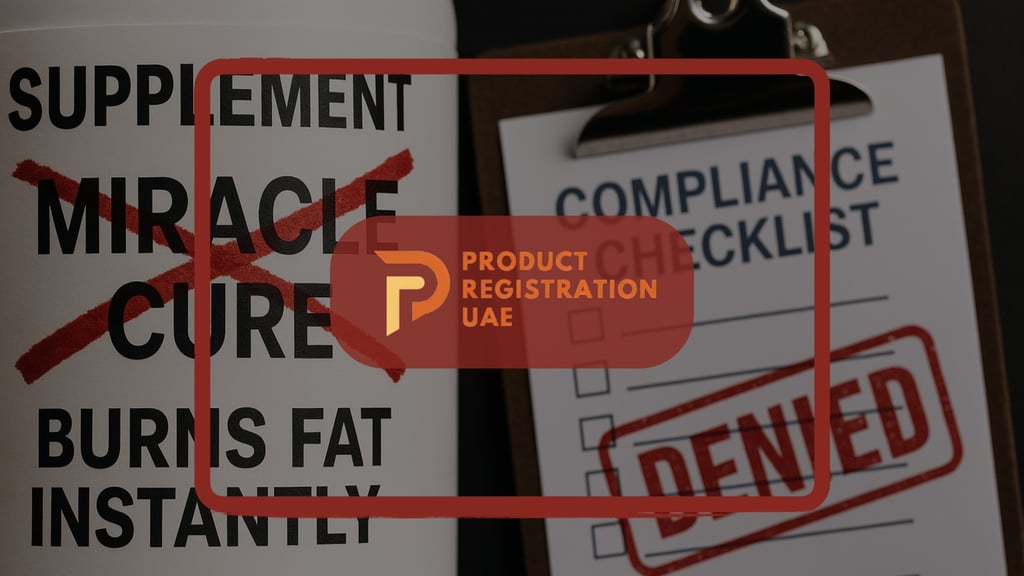
A product claim is not simply advertising copy. It can influence how a product is classified, what evidence is expected and which regulatory route may apply.
The same wording can have different implications when used for a cosmetic, food, supplement, detergent, disinfectant or healthcare product.
Claim compliance should therefore be assessed before:
Finalising packaging artwork
Translating the label
Submitting a registration application
Printing commercial quantities
Publishing product descriptions
Producing advertising materials
The relevant authority makes the final classification and acceptance decision. There is no universal list of words that guarantees approval.
What Is Considered a Product Claim?
A product claim is any statement, image, symbol or presentation that communicates what a product is, what it contains or what it is expected to do.
Claims may appear in:
Product names
Packaging labels
Directions for use
Product descriptions
Images and symbols
Leaflets
Websites
Marketplace listings
Brochures
Advertising materials
Social-media content
A claim can be direct or implied.
For example, a label may not explicitly describe a product as medical, but disease imagery, clinical symbols, before-and-after photographs or treatment-style instructions may create that impression.
Claims should be reviewed as part of the product’s complete presentation—not as isolated sentences.
The Three-Part Claim Compliance Test
Every important claim should be assessed against three questions.
1. Is the Claim Appropriate for the Product Category?
The wording should be consistent with the product’s intended use and likely classification.
A cosmetic claim should not present the product as diagnosing, treating or curing a medical condition. A food or supplement claim should not automatically be treated as acceptable simply because an ingredient is associated with a particular benefit.
2. Does the Evidence Support the Exact Claim?
The strength and specificity of the evidence should correspond with the strength and specificity of the statement.
Generic ingredient information may not support a claim about the finished product. Evidence from another formula, concentration or method of use may also be unsuitable.
3. Is the Claim Consistent Everywhere?
The label, formula, application, technical documents and marketing content should describe the same product and intended purpose.
Contradictory claims can create uncertainty about classification or the evidence being relied upon.
Claims That Can Affect Product Classification
Therapeutic and Disease-Related Claims
Statements suggesting that a product diagnoses, treats, cures, prevents or controls a disease can move it beyond an ordinary cosmetic, food or consumer-product category.
Examples requiring careful review include claims involving:
Treatment of a named disease
Pain relief
Infection prevention
Hormonal effects
Permanent physiological change
Healing damaged tissue
Medical or pharmaceutical action
Whether wording is acceptable depends on the full product presentation, composition, intended use and applicable route.
Antimicrobial and Disinfection Claims
Cleaning and disinfecting are not interchangeable claims.
Statements involving bacteria, viruses, fungi, sanitisation, disinfection or percentage reduction may require appropriate classification and efficacy evidence.
Relevant factors can include:
Target organism
Product concentration
Dilution
Contact time
Test method
Application surface
Directions for use
Active ingredients
A test result should not be extended to organisms, uses or conditions that were not evaluated.
Nutritional, Health and Wellness Claims
Food and supplement claims can create classification or evidence questions when they refer to body functions, nutrient benefits, health conditions or therapeutic outcomes.
The claim should be assessed against:
Product composition
Ingredient quantity
Intended serving
Target consumer
Required warnings
Available evidence
Applicable product category
A widely used international claim is not automatically appropriate for the UAE product or route.
Cosmetic Performance Claims
Cosmetic claims should remain consistent with the product’s intended cosmetic purpose.
Particular attention may be required for wording involving:
Acne
Pigmentation or whitening
Hair growth
Skin repair
Inflammation
Cell regeneration
Clinical or medical effects
Permanent results
The formula, mechanism implied and overall product presentation should be considered together.
Certification and Quality Claims
Statements such as certified, approved, tested, organic, natural, Halal, medical grade or compliant should only be used when they are accurate and supported.
Review:
Who issued the certificate
What product or facility it covers
Its validity
Its geographical scope
Whether the mark may be displayed
Whether the claim applies to the finished product
Whether qualifications or limitations are omitted
A manufacturing certificate should not be presented as though it were a government product approval.
Environmental Claims
Claims such as biodegradable, recyclable, sustainable, environmentally friendly or non-toxic require particular care.
The claim should clearly identify what it applies to: the formula, packaging, manufacturing process or another defined feature.
Broad environmental statements without clear scope or evidence can mislead consumers.
Comparative and Absolute Claims
Words such as best, safest, number one, guaranteed, completely safe, instant and permanent are difficult to substantiate because they make absolute or comparative promises.
If a claim compares one product with another, the comparison method, tested products and measurable criteria should be clear and supportable.
What Makes Claim Evidence Relevant?
Strong evidence should correspond with:
The exact finished product
The submitted formulation
Relevant ingredient concentrations
The proposed dosage or method of use
The target consumer
The claimed result
The test conditions
The intended market presentation
Depending on the product and claim, evidence may include:
Finished-product test reports
Efficacy studies
Safety assessments
Stability information
Product specifications
Recognised technical references
Ingredient documentation
Certificates issued by an appropriate body
Possessing a report does not automatically validate a claim. The report must support the precise wording and conditions being presented.
English and Arabic Claims Must Remain Aligned
Translation can change the regulatory meaning of a statement.
The Arabic wording should not:
Add a therapeutic meaning
Strengthen the promised effect
Remove a limitation
Change the intended use
Omit an important warning
Introduce a claim absent from the English version
Technical claim translation should be reviewed in the context of the product category, not only for grammar.
Build a Claim Inventory Before Finalising Artwork
Create one controlled list containing every proposed claim.
Include claims from:
Front and back labels
Product names
Leaflets
Website copy
Marketplace descriptions
Product images
Advertising materials
For each claim, record:
The exact wording
Where it will appear
The intended meaning
The product category
The supporting evidence
Any qualification or limitation
The corresponding Arabic wording
Whether it could affect classification
This process makes unsupported wording easier to identify before submission.
A Practical Pre-Submission Claims Review
Step 1: Confirm the Intended Use
Define what the product is designed to do and who will use it.
Step 2: Confirm the Likely Classification
Assess whether the formula, intended use and claims point to the same product category.
Step 3: Extract Every Claim
Review the complete artwork and supporting marketing materials. Do not assess only the front label.
Step 4: Map Each Claim to Evidence
Identify the exact document supporting each claim and determine whether it applies to the submitted product.
Step 5: Review English and Arabic Together
Check that both versions communicate the same meaning and limitations.
Step 6: Resolve Unsupported or High-Risk Wording
Possible actions may include narrowing the statement, adding a qualification, obtaining suitable evidence or reconsidering the proposed classification.
Step 7: Freeze the Reviewed Version
Maintain one approved internal version so that later marketing changes do not reintroduce unsupported claims.
This review does not guarantee authority acceptance, but it can identify avoidable inconsistencies before filing.
Warning Signs That Require Further Assessment
Pause the artwork or submission when:
A non-medical product refers to treating or curing a condition.
Antimicrobial claims lack product-specific evidence.
The Arabic wording is stronger than the English.
A claim relies only on ingredient-level information.
A certificate applies to a facility rather than the finished product.
Test conditions differ from the proposed directions.
Foreign packaging has been reused without UAE review.
Marketing content exceeds the submitted label.
A product uses medical imagery despite a non-medical category.
A claim cannot be traced to a specific supporting document.
Frequently Asked Questions
Is there a list of claims that are always permitted?
No. Claim acceptability depends on the product category, formulation, wording, evidence and intended use. A phrase cannot be assessed responsibly without its context.
Does avoiding the word “cure” make a claim acceptable?
Not necessarily. Words such as treats, prevents, heals, corrects or eliminates may still imply therapeutic action. Images and overall presentation can also create a medical implication.
Can ingredient research support a finished-product claim?
Sometimes, but not automatically. The ingredient form, concentration, combination, dosage and finished-product use must be considered.
Can claims approved in another country be used in the UAE?
Foreign approval does not automatically establish UAE acceptance. The local category, authority and requirements should be assessed.
Does a disclaimer correct an unsupported claim?
A disclaimer does not automatically neutralise a prominent or misleading statement. The complete presentation must be reviewed.
Do website and marketplace claims matter?
Yes. Public product information should remain consistent with the registered product identity, label and supported purpose.
Is claim review the same as legal advice?
No. Regulatory claim assessment reviews classification, evidence and submission consistency. Legal advice should be obtained from a qualified legal professional when required.
Request a Product Claims Assessment
For an initial assessment, provide:
Product name and intended use
Complete formula or specifications
Product category, if known
Complete English and Arabic artwork
Every proposed product claim
Available test reports and supporting evidence
Manufacturer and country of origin
Intended UAE market
We can assess whether the proposed claims fall within our service scope and identify wording, evidence or classification issues that should be addressed before submission.
Need help reviewing your product claims before finalising the label? Contact us or use the chatbot in the bottom right corner to request an initial product claims assessment.
Don’t Miss These Compliance Essentials:
Avoid labeling issues in What UAE Authorities Check on Supplement Labels
Learn how translation can distort claims in Arabic Label Translation Rules Every Brand Must Know
Understand the risks in What Are the Penalties for Non-Compliance in UAE?
Catch compliance issues before submission — see how gap analysis saves time and approvals.