Post-Approval Compliance: Avoid Suspensions After Approval
Post-approval compliance in the UAE explains how regulatory changes, labeling drift, and uncontrolled updates lead to suspensions—and how to prevent them.
1/26/2026
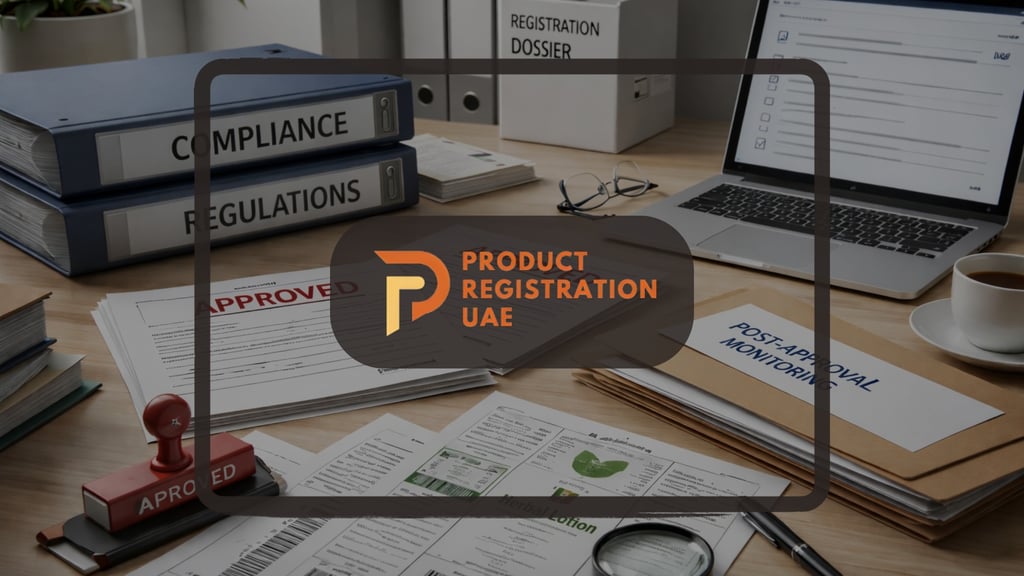
Why Post‑Approval Compliance Is Where Most UAE Product Failures Happen
Many brands assume that once a product is approved, the regulatory risk is over. In the UAE, the opposite is often true.
Post‑approval compliance is where products quietly fail—through unnoticed regulatory changes, misaligned updates, distributor actions, or internal process gaps.
These failures rarely trigger immediate rejection but instead surface later as suspensions, forced variations, fines, or market withdrawals.
This guide focuses on what happens after approval—the phase most brands underestimate—and how to maintain regulatory continuity across Dubai Municipality, MOHAP, ECAS/EQM, and related authorities.
Reviewed by: Product Registration UAE Regulatory Team
What Post‑Approval Compliance Actually Covers in the UAE
Post‑approval compliance is not a single task or annual checkbox. It is an ongoing obligation to ensure that the product on the market remains identical—in substance and documentation—to what was approved.
In the UAE, post‑approval compliance typically includes:
Continuous alignment with evolving authority requirements
Managing product changes (intentional or unintentional)
Monitoring supplier and formulation stability
Ensuring labeling, claims, and language remain compliant
Maintaining traceability and documentation readiness
Failure in any one of these areas can invalidate an existing approval.
The Most Common Post‑Approval Risks Brands Miss
Silent Regulatory Changes
Authorities update technical circulars, internal review standards, and interpretation rules more frequently than formal laws.
These changes are not always publicly announced, yet they affect how existing products are reviewed during renewals, audits, or complaints.
Products approved years earlier may suddenly be evaluated against stricter expectations.
Uncontrolled Product Changes
Seemingly minor changes often trigger compliance issues, such as:
Ingredient source substitutions
Supplier reformulations
Manufacturing site changes
Packaging material changes
Artwork or label redesigns
If these changes are not assessed through a regulatory lens, brands may unintentionally market an unapproved product.
Distributor‑Driven Risks
In many cases, distributors update labels, claims, or product positioning without understanding regulatory boundaries. When authorities inspect the product, the brand—not the distributor—bears the compliance risk.
Clear post‑approval governance between brand owners and local distributors is essential.
Label Drift Over Time
Labels evolve for marketing reasons. Claims expand, wording shifts, design elements change. Over time, labels often drift away from what was originally approved, especially in Arabic translations.
This is one of the most common triggers for objections during renewals or inspections.
Why Authorities Focus More on Post‑Approval Than Initial Submission
Initial submissions are structured and controlled. Post‑approval environments are not.
Authorities place significant weight on post‑market behavior because it reflects real‑world compliance.
Inspections, complaints, renewals, and enforcement actions are all based on what is actually sold—not what was once approved.
A strong initial submission does not protect against weak post‑approval controls.
The Role of Regulatory Change Management
Effective post‑approval compliance requires an internal system for tracking and assessing regulatory change.
This includes:
Monitoring authority updates relevant to your product category
Assessing impact on existing approvals
Deciding whether variations, notifications, or corrective actions are required
Documenting decisions for audit readiness
Without a structured change management process, brands operate reactively—often too late.
When Variations Are Required—and When They Are Not
Not every change requires authority notification, but many do. The challenge is knowing the difference.
Incorrect assumptions lead to two risks:
Over‑reporting, which creates unnecessary delays and scrutiny
Under‑reporting, which creates compliance exposure
A defensible variation strategy is based on risk assessment, authority practice, and documentation—not guesswork.
Post‑Approval Compliance Is a Business Risk, Not Just a Regulatory One
Regulatory disruptions affect:
Sales continuity
Distributor relationships
Market credibility
Contractual obligations
Expansion timelines
Brands that treat post‑approval compliance as a strategic function—not an administrative one—move faster and with fewer surprises.
Building a Sustainable Post‑Approval Framework
A strong framework typically includes:
Clear ownership of regulatory decisions
Defined change control procedures
Periodic compliance reviews
Label and claim governance rules
Document version control
Distributor compliance clauses
This framework reduces dependency on crisis management and enables predictable market operations.
Addressing Common Questions About Product Registration in the UAE
How do you register your product in the UAE?
Product registration in the UAE involves submitting a complete regulatory dossier to the relevant authority based on product type, such as Dubai Municipality, MOHAP, or ECAS/EQM.
Beyond initial approval, brands must ensure that the marketed product continues to match the approved version, as post‑approval deviations are a leading cause of regulatory action.
How much does it cost to register a product in Dubai?
Registration costs vary depending on product category, authority fees, testing requirements, and the quality of the initial submission.
However, the most significant costs often arise after approval, when unmanaged changes or non‑compliance lead to re‑submission, relabeling, or market disruption.
How to trade online in compliance with UAE regulations?
Selling products online in the UAE requires that both the business license and the product approvals remain valid and aligned. Online listings are routinely reviewed against approved labels, claims, and product scope, making post‑approval compliance essential for uninterrupted e‑commerce operations.
Can I sell online without a license in the UAE?
No. Selling products online without a valid trade license and compliant product approvals exposes businesses to enforcement actions, delisting, and penalties. Authorities increasingly monitor digital marketplaces as part of post‑market surveillance.
Final Takeaway
In the UAE, approval is not the finish line—it is the starting point. Brands that succeed long-term are those that control what happens after approval, not just what gets approved.
Post-approval compliance is where regulatory maturity shows. Getting it right protects approvals, reputations, and revenue.
Contact us or use our chatbot in thebottom right corner for complaince assistance.
Continue Exploring Compliance Insights
Learn how regulatory pre-screening helps identify post-approval risks before they escalate.
Understand why Arabic labeling alignment remains one of the most common triggers for market objections.
Discover how regulatory gap analysis supports long-term compliance across growing product portfolios.
If renewals keep getting harder, this guide on regulatory change control shows the exact changes that trigger suspensions and forced variations.