Regulatory Submission Checklist for UAE Products
Use this regulatory submission checklist to review classification, applicant eligibility, labels, claims, documents, evidence and variants before filing.
10/6/2026
How to Use This Regulatory Submission Checklist
Reviewed by: Product Registration UAE Regulatory Team
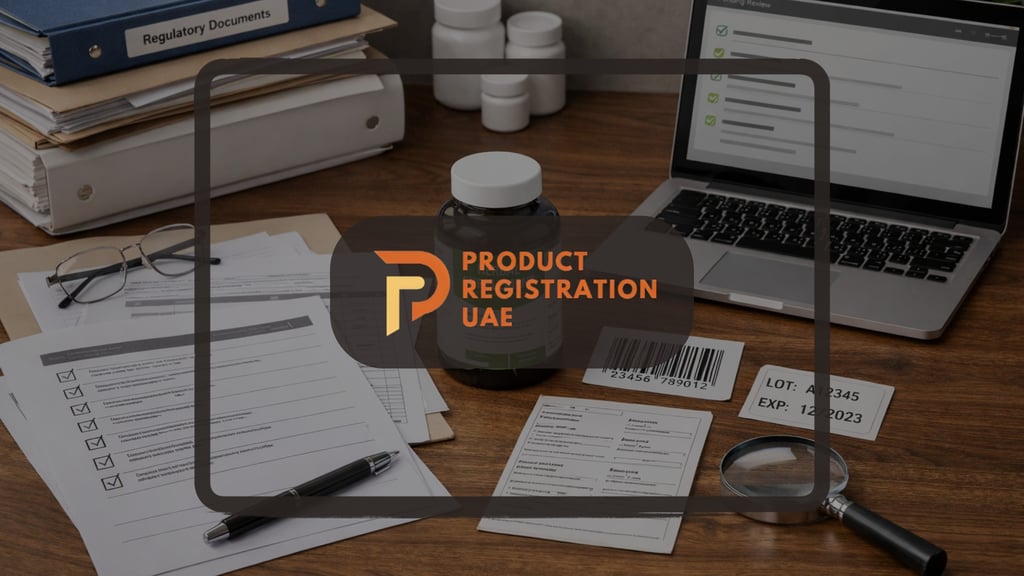
A regulatory submission should present one clear and consistent account of the product being assessed.
The product name, intended use, formulation, manufacturer, label, claims, supporting documents and applicant details should refer to the same product and proposed market route.
This checklist is not a universal list of mandatory documents. UAE requirements vary by product category, authority and jurisdiction. Use it to identify inconsistencies before submitting, printing final packaging or ordering documents that may not apply.
1. Confirm the Product Classification and Regulatory Route
Begin with what the product is, what it contains and how it will be used.
Do not select a category based only on the product name, appearance or the category used in another country.
Review:
Intended use
Target user
Method and location of application
Formulation or composition
Active ingredients where applicable
Directions for use
Label and advertising claims
Proposed UAE market
Whether the product will be imported or manufactured locally
Claims can affect classification. For example, therapeutic, antimicrobial, nutritional or disease-related wording may move a product outside its expected category.
The applicable authority and submission route should be identified before preparing the final dossier.
2. Confirm Applicant and Establishment Eligibility
A complete product file may still be unsuitable for submission if the proposed applicant is not eligible for the selected route.
Confirm:
The applicant is an appropriately licensed UAE entity.
Its commercial activities are relevant to the product.
Any required establishment registration is current.
Manufacturer, brand-owner and applicant relationships are documented.
Authorisation documents identify the correct parties.
The applicant details match the information used throughout the submission.
A foreign manufacturer may require an eligible UAE importer, distributor, local manufacturer, marketing-authorisation holder or other authorised applicant, depending on the product.
Applicant eligibility should be checked before government fees are paid or the application is filed.
3. Establish One Master Product Identity
Create a master product summary and use it as the reference point for every document.
Record:
Exact brand name
Exact product name
Product description
Intended use
Manufacturer name and address
Manufacturing site
Country of origin
UAE applicant details
Pack size
SKU
GTIN or barcode where applicable
Formula or model reference
Flavour, fragrance, colour or other variant
Storage conditions
Shelf life where applicable
Names, addresses and identifiers should be written consistently.
Small differences in spelling, spacing, company suffixes or product descriptions can make it unclear whether documents refer to the same product.
4. Reconcile the Formula, Specifications and Evidence
Technical evidence must apply to the product being submitted.
Check that:
The formula is complete and current.
Ingredient names and units are consistent.
Ingredient concentrations are clear where required.
The formula corresponds with the label declaration.
Product specifications use the same identity and version.
Test samples represent the submitted product.
Reports support the relevant use or claim.
Manufacturer-issued documents identify the correct site.
Dates, signatures and document versions are visible.
Translations preserve the meaning of the original documents.
Depending on the category, supporting information may include specifications, a Certificate of Analysis, Safety Data Sheet, stability information, safety assessment, efficacy evidence or other technical records.
Not every product requires every document. Evidence should be selected according to the actual category and regulatory route.
5. Review the Complete Label and Every Claim
Review all sides of the packaging—not only the front panel.
Check:
Product and brand names
Product function
Ingredient declaration
Active ingredients where applicable
Directions for use
Dosage or dilution instructions where applicable
Warnings and precautions
Storage conditions
Net quantity
Batch or lot information
Production and expiry information where applicable
Manufacturer details
Country of origin
UAE applicant or importer details where required
Required Arabic content
Certification marks
Marketing and performance claims
The artwork should match the supporting file.
A label should not introduce a use, benefit, certification or performance claim that is absent from—or unsupported by—the technical evidence.
Review the final artwork before printing. Draft labels and foreign-market artwork may not represent the version intended for the UAE.
6. Validate Documents Before Uploading Them
A document is not useful merely because it exists. It must be relevant, readable and applicable.
For every document, confirm:
The issuer is clearly identified.
The product or manufacturer is correctly named.
The document applies to the relevant product, site or applicant.
The document is current.
All pages are included.
Stamps, signatures and attachments are visible where applicable.
Dates are consistent.
Any required legalisation or attestation has been completed.
The laboratory or certification body is appropriate where required.
The document does not contradict another part of the file.
Depending on the category, the submission may involve a Free Sale Certificate, manufacturing licence, GMP evidence, authorisation letter, laboratory report or other supporting record.
Do not assume that these documents are universally required. Confirm the category-specific requirements before requesting them.
7. Conduct a Final Submission-Control Review
The final review should be completed by someone who was not responsible for preparing every document, where possible.
The reviewer should confirm:
The product follows the intended regulatory route.
The applicant appears eligible.
Every document refers to the same product.
The label matches the formula and supporting records.
Claims are appropriate and supported.
Variants are clearly identified.
File names and versions are controlled.
Expired and duplicate documents have been removed.
Translations are consistent.
Required fields have been completed.
The submitted artwork is the intended market version.
The application does not include unsupported assumptions.
Maintain a dated copy of the complete submission package. This provides a reference if the authority asks a question or if the product is changed later.
Category-Specific Additions
Food and Beverage Products
Review ingredients, allergens, nutrition information, product name, storage conditions, shelf life, claims and applicable food-registration requirements.
Cosmetics and Personal-Care Products
Review the intended cosmetic use, ingredient documentation, artwork, warnings and claims that might imply a therapeutic or medical purpose.
Health Supplements
Review the ingredient quantities, serving instructions, warnings, benefit claims and any wording that could affect classification.
Detergents and Disinfectants
Distinguish ordinary cleaning claims from antimicrobial or disinfection claims. Active ingredients, directions, dilution, contact time and efficacy evidence may affect the required route.
Medical and Healthcare Products
Confirm the intended medical purpose, manufacturer and applicant arrangements before preparing product or site-registration documents. Medical products can require a different authority and submission structure from ordinary consumer products.
Products Subject to Conformity Requirements
Confirm that the exact product is regulated under the relevant technical requirements before treating ECAS, EQM or another conformity route as mandatory.
Common Pre-Submission Warning Signs
Pause the submission when:
The formula and label show different ingredients.
The manufacturer name differs between documents.
A certificate applies to a different site or product.
The artwork includes unsupported claims.
Arabic and English content communicate different meanings.
The applicant’s commercial activity appears unsuitable.
Product variants have been grouped without assessment.
A foreign approval is being treated as automatic UAE acceptance.
Testing was conducted on a different formulation.
Final packaging has already changed from the submitted artwork.
A document is expired, incomplete or illegible.
The selected authority was chosen without confirming classification.
Correcting these issues before submission is generally more controlled than responding to them after filing.
Frequently Asked Questions
Is there one regulatory submission checklist for every UAE product?
No. Required documents and procedures depend on the product, authority and intended market. This checklist is a quality-control framework, not a universal government document list.
Does a complete submission guarantee approval?
No. A complete and consistent file can reduce avoidable questions, but the competent authority makes the final classification and approval decision.
Is approval from another country enough for the UAE?
Not automatically. Foreign registrations and certificates may support a file, but the applicable UAE requirements must still be assessed.
Can several product variants be submitted together?
Possibly. Differences in formulation, flavour, fragrance, colour, size, model, claims or presentation can affect whether variants may be grouped.
Should the final packaging be printed before submission?
The artwork should be reviewed in its final intended form, but large-scale printing before regulatory review can create unnecessary rework if corrections are requested.
Does every submission require laboratory testing?
No. Testing depends on the product, category, claims and applicable technical requirements. Existing reports should be reviewed before new testing is commissioned.
Can the same applicant register every product category?
Not necessarily. Applicant eligibility depends on licensing, establishment requirements, product category and regulatory route.
Request a Pre-Submission Review
For an initial assessment, provide:
Product name and intended use
Complete formula or technical specifications
Proposed UAE applicant details
Manufacturer and country of origin
Complete label artwork
Product claims
Available certificates and technical documents
Details of all product variants
Intended UAE market
Proposed regulatory route, if already identified
We will assess whether the product falls within our service scope and identify classification, documentation, label or consistency gaps that should be addressed before submission.
Need help checking your product file before submission?
Contact us or use the chatbot in the bottom right corner to request a category-specific pre-submission review.
Related Reading for Submission Readiness
Understand the full UAE product registration process from initial submission to final approval.
Learn how regulatory gap analysis helps identify compliance risks before submission.
See what authorities typically review on labels to avoid objections and rework.
Post-approval compliance in the UAE is where most approved products fail if regulatory changes and updates are not actively managed.