Changing UAE Distributor: Product Registration Checks
Changing UAE distributor? Learn what to check across product registrations, approval holders, labels, authority records and pending shipments.
10/19/20268 min read
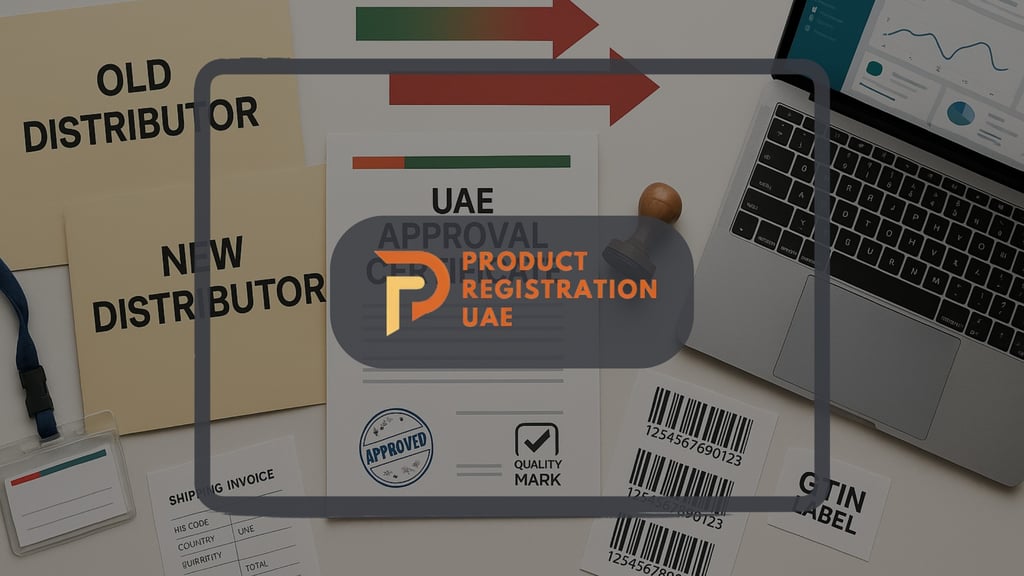
Does Changing a UAE Distributor Affect Product Registration?
Changing an importer or distributor can affect more than the commercial supply agreement.
The existing product approval may identify a particular applicant, importer, certificate holder, marketing-authorisation holder or locally licensed establishment.
That party may also control authority accounts, renewal records, approved artwork and correspondence relating to the product.
However, this does not mean every distributor change requires an approval to be transferred. It also does not mean that every existing registration can simply be reassigned to another company.
The correct regulatory response depends on:
The product category
The responsible UAE authority
The party named on the existing approval
The role performed by the outgoing company
The intended role of the incoming company
Whether product, label or supply-chain information will change
Whether the relevant system permits an amendment, variation, new appointment or new application
These points should be established before terminating the existing arrangement or shipping products through the new partner.
Distributor, Importer and Approval Holder
Are Not Always the Same
The terms distributor, importer and registration holder are often used interchangeably in commercial discussions. Their regulatory functions can be different.
A company might act as:
The commercial distributor
The importer of record
The applicant that submitted the registration
The company named on a conformity certificate
The locally licensed establishment
The marketing-authorisation holder or its representative
The party responsible for renewals and post-approval changes
The holder of an authority portal account
The party responsible for safety reporting or recalls
Changing the company that sells products to retailers does not necessarily change the regulatory applicant.
Conversely, replacing the importer may require updates even when the brand, formula and packaging remain unchanged.
The first step is therefore to identify every party shown in the approval file and determine which role is actually changing.
Can UAE Product Registrations Be Transferred to a New Distributor?
There is no universal UAE product-registration transfer procedure.
Depending on the product and authority, the appropriate route may involve:
Updating an establishment or importer record
Appointing or replacing an authorised party
Submitting an amendment or variation
Updating contact or account permissions
Obtaining a new conformity certificate
Filing a new product application
Maintaining the existing approval while changing only the commercial distributor
Completing separate regulatory and customs updates
An approval should not be described as transferable until the relevant authority, service rules and certificate details have been reviewed.
The outgoing distributor’s consent or supporting documents may also be required in some situations.
Contractual control over the registration file is therefore important, but a private agreement cannot by itself amend an authority record.
Which Records Should Be Reviewed Before the Change?
Create an approval inventory covering every product and variant affected by the proposed switch.
For each item, record:
Product name
Product category
Responsible authority
Registration or certificate number
Issue and expiry dates
Applicant or approval holder
Importer or local establishment
Manufacturer
Brand owner
Model, size, flavour or variant
Barcode or GTIN
Current label version
Pending renewal or variation
Authority account controlling the record
Supporting documents held by each party
This inventory helps distinguish approvals that may continue unchanged from records that require an update or new application.
Do not assume that all products under the same brand will follow the same route.
A portfolio containing cosmetics, food, supplements, detergents, electrical equipment and medical products may involve several authorities and different applicant requirements.
Changing a Distributor for Dubai Municipality Products
Dubai Municipality product records should be reviewed according to the relevant product category and the company information attached to the applicable system.
The review should establish:
Which establishment controls or maintains the product record
Whether the incoming company has the required licensed activity
Whether the product is correctly associated with the responsible establishment
Whether importer or local company information appears on the approved label
Whether an update can be submitted or another application is required
Whether existing variants and barcodes remain covered
Whether any renewal or amendment is already in progress
Montaji should not be treated as a transferable certificate that automatically moves between distributors.
The product record, establishment eligibility and approved information must be checked together. A commercial appointment letter alone may not be enough to update the regulatory position.
What Happens to ECAS or Other Conformity Certificates?
For regulated products under the Ministry of Industry and Advanced Technology, inspect the existing conformity certificate and its supporting file before changing the supply arrangement.
Confirm:
The applicant or organisation named on the certificate
The certificate’s validity
The models, products or variants within its scope
The manufacturing facility
Applicable test reports and declarations
The responsible notified body, where relevant
The incoming company’s trade-licence eligibility
Whether certificate information must be amended
Whether the applicable route permits an update or requires a fresh application
A distributor change does not automatically invalidate every conformity certificate. Equally, a certificate issued using the outgoing company’s information should not be assumed to cover a new applicant or importer.
The applicable certificate and conformity route need to be assessed individually.
Medical and Healthcare Products: Use Current EDE Terminology
Medical and healthcare product matters should now be assessed through the applicable Emirates Drug Establishment framework—not described broadly as “MoHAP approvals.”
For these products, distinguish carefully between:
The manufacturer
Marketing-authorisation holder
Local representative or marketing office
Licensed medical warehouse
Authorised agent
Applicant
Importing establishment
Commercial distributor
Current EDE services distinguish marketing authorisation, licensed establishments, import permissions, renewals and amendments to registered product data.
A change in commercial distributor may therefore be different from changing the marketing-authorisation holder, authorised agent or importing warehouse. Each proposed change should be mapped to the applicable EDE service and supporting documents.
The product’s medical registration, establishment licences and import arrangements must remain aligned throughout the transition.
Do Labels Need to Change When the Importer Changes?
Possibly.
Review the label whenever the outgoing company’s name, address or role appears on:
Outer packaging
Inner packaging
Arabic label text
Stickers
Instructions for use
Consumer information
Warranty or service information
Marketplace images
Product leaflets
Do not replace the company details on finished artwork without checking whether the change must first be reported or approved.
The revised artwork should also be compared with the current regulatory file to ensure that no unintended changes were introduced to:
Product claims
Ingredients
Warnings
Directions
Country of origin
Manufacturer details
Pack size
Model information
Barcodes
Certification marks
A distributor transition is not an opportunity to introduce uncontrolled marketing changes.
For further guidance on claim-related risks, read UAE Product Claims Compliance.
What Documents Should the Brand Obtain from the Outgoing Distributor?
Document control is one of the most important parts of the transition.
Subject to ownership rights and contractual arrangements, the brand should determine whether it has complete copies of:
Current approval certificates
Submitted application forms
Authority correspondence
Approved label artwork
Product images
Formulas or specifications
Test reports
Certificates of Analysis
Free Sale Certificates
Manufacturer authorisations
Powers of attorney or appointment letters
Renewal and variation records
Payment receipts
Portal reference numbers
Inspection or surveillance correspondence
Complaint and recall records
Import or shipment records relevant to the approval
Do not rely on files remaining in an outgoing employee’s email account or a distributor-controlled portal.
Missing submission history can make future renewals, authority responses and label amendments more difficult even when the approval itself remains valid.
Should Portal Access Be Transferred?
Portal access and regulatory ownership are not the same thing.
User accounts may be linked to an individual, UAE Pass identity, licensed company or authority-approved establishment. Login credentials should not simply be shared with the incoming distributor.
Instead, determine:
Which company legally controls the authority record.
Which users currently have access.
Whether new users can be added.
Whether the establishment or applicant must first be amended.
Which pending applications remain open.
Who will respond to authority requests during the transition.
When obsolete permissions should be removed.
Access should only be changed through the relevant system’s permitted process. Removing the outgoing party too early can interrupt pending work, while leaving uncontrolled access can create conflicting submissions.
What If a Renewal or Variation Is Already in Progress?
Identify every pending application before setting the transition date.
A renewal, label amendment, formula change or certificate update may need to be completed by the existing applicant. In other cases, the authority may require the proposed company change to be addressed first.
Check:
Application status
Outstanding authority questions
Payment status
Submission deadlines
Approval expiry date
Whether the applicant can still respond
Whether the change affects information under review
Whether a second filing would conflict with the first
Avoid submitting duplicate applications from the old and new companies unless the responsible authority expressly requires them.
The UAE Product Registration Renewals guide explains how to assess expiring approvals and product changes before filing.
What If a Shipment Is Already on the Way?
An inbound shipment makes the transition more time-sensitive, but it does not justify promising uninterrupted clearance.
Review:
The importer shown on the shipment documents
Commercial invoice and packing list
Product registration or conformity evidence
Certificate validity
Product names and model numbers
GTINs or barcodes
Labelled importer information
Import permits required for the category
Customs registration of the receiving company
Pending regulatory amendments
The documents should reflect the actual approved and licensed supply arrangement.
Do not revoke appointments, alter importer details or dispatch replacement labels merely to match an approaching shipment without confirming the regulatory consequences.
If the necessary change cannot be completed before arrival, the possible clearance, storage, re-export or corrective routes should be assessed with the relevant authority and logistics parties.
Can One UAE Registration Be Used by Multiple Distributors?
Sometimes the commercial distribution network can include more than one distributor, but that does not mean every company becomes the regulatory holder or importer automatically.
The answer depends on:
The product category
Authority rules
Existing approval structure
Establishment licences
Import arrangements
Appointment documents
Label information
Responsibility for post-market obligations
Current rules for medical products may also involve specific authorised-agent and establishment arrangements that should not be generalised to food, cosmetics, conformity-regulated products or other categories.
Before appointing multiple partners, define who controls the registration, who may import, who maintains the approval and who responds to safety or authority matters.
Who Is Responsible for Complaints and Recalls After the Change?
Responsibility should be documented before commercial handover.
The transition plan should identify:
Who receives product complaints
Who evaluates safety or quality concerns
Who maintains distribution records
Who contacts the manufacturer
Who reports to the responsible authority
Who coordinates withdrawal or recall activity
Who retains historical records
When the new responsibility becomes effective
The outgoing party may still hold information concerning products supplied before the transition. Access to that information should be preserved for the required retention period.
A commercial change should not create a gap in traceability or post-market responsibility.
A Practical Pre-Change Readiness Check
Before changing the UAE importer or distributor, confirm:
Every product and approval has been inventoried
The outgoing and incoming parties’ regulatory roles are understood
The named applicant or approval holder has been identified
The incoming company’s licences and activities are suitable
The correct authority process has been confirmed
Expiring and pending applications have been reviewed
Required appointment and authorisation documents are available
Approved labels have been compared with proposed artwork
All models, variants and barcodes have been mapped
Regulatory files have been securely collected
Portal permissions have been planned
Incoming shipments have been assessed
Complaint, recall and record-retention responsibilities are assigned
Do not end the existing arrangement until the brand understands which regulatory dependencies remain attached to it.
Frequently Asked Questions
Does changing a UAE distributor cancel product registration?
Not automatically. The effect depends on the product category, authority, approval holder and role of the outgoing distributor. Some changes may be commercial only; others may require an amendment, new appointment or new application.
Can the outgoing distributor refuse to transfer an approval?
The answer depends on the authority record, contractual arrangements and applicable process. A brand’s ownership of the trademark or product does not necessarily give it direct control of an approval submitted under another company’s account.
Can we use the existing labels after appointing a new importer?
Only after checking whether the existing importer details remain accurate and whether label changes require notification or approval. Products should not be placed on the market with misleading or outdated responsible-party information.
Should we change the distributor before renewing the registration?
There is no universal sequence. The approval’s status, expiry date, pending submissions and authority procedure should be reviewed before deciding whether renewal or the company change comes first.
Will the new distributor need new product registrations?
Possibly. Some records may continue or be updated, while others may require a new application. This must be determined separately for each authority and product category.
How long does a UAE distributor change take?
There is no standard timeframe. It depends on the number of products, authority procedures, cooperation from the outgoing party, incoming-company eligibility, document availability and whether new submissions are required.
Plan the Regulatory Change Before the Commercial Handover
Changing a UAE distributor should begin with an approval and responsibility assessment—not with portal-password exchanges or immediate label replacement.
The objective is to determine which records can continue, which information must be updated and which products require a different regulatory route.
This protects the registration file, reduces avoidable shipment problems and gives the incoming partner a clear operating position.
Preparing a first UAE application as part of the new arrangement?
Read the First-Time Product Registration UAE guide.
Need help assessing a proposed importer or distributor change?
Contact us or use the chatbot in the bottom right corner for a product-by-product review of your existing approvals, labels, responsible parties and pending applications.
Keep Reading:
For role clarity during a distributor handover, read Importer vs AR UAE: Who Files, Labels & Recalls.
Planning label or pack changes mid-switch? See Post-Approval Variations Guide.
Not sure what’s missing before you switch? Start with Regulatory Pre-Screening UAE.
Read Who Must Register Products in the UAE—and Who Doesn’t for a clear checklist on when approval is mandatory and how to avoid border holds.